Session 8: Biogas as a Business#
Learning Objectives#
By the end of this session, you will be able to:
Identify the different ways biogas and bio-slurry can generate income.
Understand the basics of costing and pricing a biogas installation service.
Recognise the wider community impact a single trained technician can have.
Testimony: Biogas as a Career#
Sanile shares her experience as a biogas technician and course participant.
Case Study: Benefits of Biogas — Reduced Costs#
Mr Musugu on the financial benefits of biogas: reduced wood, reduced charcoal, and cash savings.
The Business Opportunity#
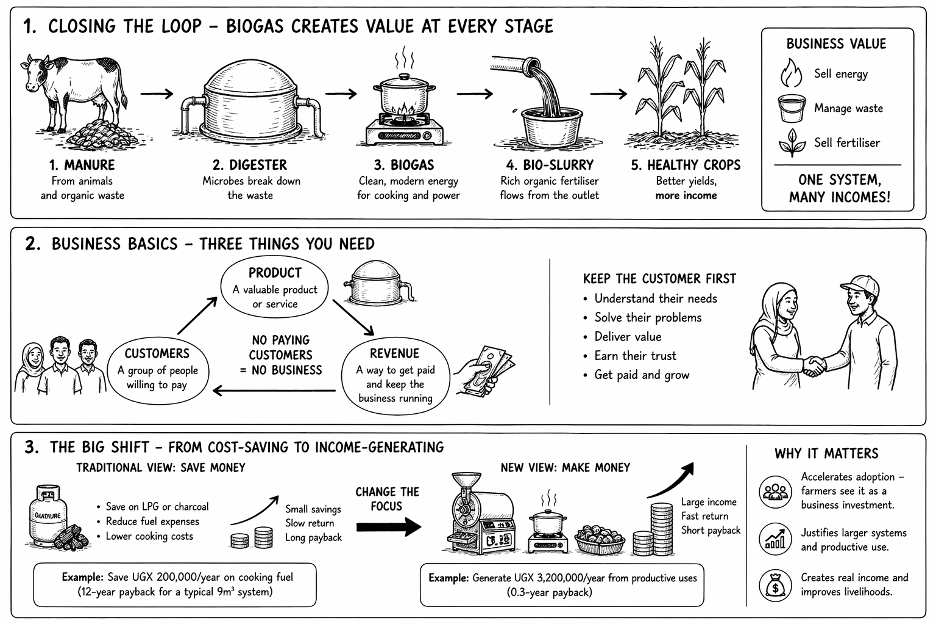
Fig. 32 Biogas creates value at every stage of the cycle — from fuel savings to bio-slurry sales — and shifts the household from a cost-generating to an income-generating model.#
Biogas creates income in three main ways:
1. Cost Savings (for the digester owner)#
Saving |
Typical impact |
|---|---|
Cooking fuel (firewood / charcoal / LPG) |
Eliminated or greatly reduced |
Chemical fertiliser |
Replaced by bio-slurry |
Labour (collecting firewood) |
Saved — often hours per day, especially for women |
Health costs |
Reduced respiratory illness from cooking smoke |
2. Productive Use Income (covered in Session 6)#
Brooding services
Fodder chopping
Food drying and processing
Lighting for evening businesses
3. Building and Maintaining Digesters as a Service#
Trained technicians can offer:
Service |
Revenue model |
|---|---|
Digester construction |
One-off fee per installation |
Annual maintenance checks |
Annual service contract |
Pipe repairs and valve replacement |
Call-out fee |
Training local farmers |
Workshop fee or donor-funded |
Real Costs and Savings: Example from the Field#
Case: A Typical 5-Cow Household Digester#
Item |
Before biogas |
After biogas |
|---|---|---|
Firewood cost (per month) |
$15–25 |
~$0 |
Fertiliser cost (per season) |
$40–60 |
~$0–20 (supplemented by bio-slurry) |
Time collecting firewood |
1–2 hours/day |
0 |
Cooking smoke exposure |
Daily |
Eliminated |
Annual savings: approximately $200–350 USD — often comparable to the installation cost within the first year.
The Community Multiplier Effect#
One trained biogas technician in a community can:
Install 10–20 digesters per year
Train other community members in operation and maintenance
Build a reputation that generates referrals
Develop an ongoing maintenance income stream
The broader effects:
Reduced deforestation (fewer trees cut for firewood)
Improved soil health (bio-slurry applied across multiple farms)
Reduced indoor air pollution across the community
Testimony: Benefits, Time, and Wellbeing#
Mrs Linguina on the personal impact of biogas: time saved, soot eliminated, and quality of life.
Testimony: Friends with Nature — Sandy#
Building a Biogas Business#
Biogas offers multiple services to people: clean, modern and free energy, effective waste management, and quality organic fertiliser. To bring these benefits to more people, we cannot rely on charitable giving alone. Business is the most effective means to expand the benefits of biogas in a financially sustainable way.
To start a successful biogas business you need three things:
A product or service — a valuable offering that meets customer needs.
A market — a group of people willing to pay for it.
A revenue model — a sustainable way to generate income and keep the business running.
The business can only work if there are enough paying customers to provide income. Keep the customer at the forefront of your mind and build your business around their unmet needs.
Types of Biogas Business#
There are three main models:
Model |
Description |
|---|---|
Product-based |
Construct and install biogas systems for households, schools, or institutions. May also include service and maintenance contracts. |
Gas service-based |
Build a large plant and supply biogas to nearby customers — works well with consistent waste supply (zero-grazed animals, community toilets). |
Productive-use based |
Use biogas to produce another product or service — roasting coffee, cooking food, running a small manufacturing process. |
Before You Start#
Consideration |
Questions to ask |
|---|---|
Knowledge and expertise |
Do you have the technical skills to build and maintain systems? |
Market demand |
Who are your potential customers? What are their needs? |
Regulatory requirements |
Are there local safety or legal regulations that apply? |
Financial planning |
How will you fund the business and ensure profitability? |
Finding a Founding Team#
Starting a business is easier and more successful with a team. A strong founding team should cover:
Technical skills — biogas construction and maintenance expertise
Financial management — budgeting, pricing, and accounting
Marketing and sales — ability to attract and retain customers
Creating a Market#
Building a market requires understanding your customers. Key steps:
Market research — Identify who benefits from biogas and what challenges they face.
Demonstration projects — Show potential customers how biogas works and the benefits it provides.
Customer education — Provide training and support so people feel confident using biogas.
Business Operations and Procurement#
Efficient operations are essential. Consider:
Supply chain management — Ensure a steady supply of construction materials.
Equipment sourcing — Find reliable suppliers for system components.
Service delivery — Set up processes for installation, maintenance, and troubleshooting.
Seed Funding#
Every business needs initial capital. Possible sources:
Source |
Notes |
|---|---|
Personal savings |
Investing your own money reduces dependence on others |
Grants and competitions |
Organisations that support renewable energy initiatives |
Loans and microfinance |
Banks or microfinance institutions |
Partnerships |
NGOs, government agencies, or investors who share your vision |
Marketing and Sales#
Effective strategies for attracting customers:
Word-of-mouth — Encourage satisfied customers to share their experiences.
Community engagement — Host workshops or demonstrations to raise awareness.
Online presence — Social media and websites reach a broader audience.
Partnerships — Work with local businesses or organisations to promote biogas.
The Business Model Shift: From Cost-Saving to Income-Generating#
Traditionally, biogas has been positioned as a cost-saving technology:
“Save money on LPG or charcoal” · “Reduce your fuel expenses”
This positioning has limitations. If a family already spends little on fuel, the savings may not justify the digester investment (UGX 2.5 million for a typical 9 m³ system — a 12-year payback).
Productive use changes this equation fundamentally. It transforms biogas from a cost-saving technology into an income-generating asset:
Framing |
Annual value |
Payback period |
|---|---|---|
Cost saving (“save on cooking fuel”) |
UGX 200,000/year |
12 years |
Income-generating (“brooding services + briquette sales”) |
UGX 3,200,000/year |
0.3 years |
This reframing is critical for:
Accelerating biogas adoption among farmers who see it as a business investment, not just a household expense.
Justifying larger digesters that can support both household use AND productive applications.
Creating sustainable businesses around biogas services (brooding-as-a-service, food processing, etc.).
Note
Building a biogas business requires commitment, a strong team, and careful planning. A customer-driven approach — always asking “what does this person need?” — is the single most important habit for long-term success.
Business Planning Worksheet#
Download and complete this worksheet to build your own biogas business plan:
Session 8 Quiz#
MC Q1. What are the three main ways a biogas system generates financial value for a farm?
Number Q2. Approximately how much can a typical 5-cow household digester save per year in firewood and fertiliser costs (USD)?
Give the approximate midpoint of the range mentioned in the session.
MC Q3. Beyond cost savings for the owner, what wider community benefit does a biogas digester provide?
Fill in Q4. A trained biogas technician can earn recurring income by offering annual ___ contracts to digester owners.
MC Q5. How many digesters can a single trained technician typically install per year?
True / False Q6. Bio-slurry (digestate) is a valuable organic fertiliser that is produced as a by-product every time the digester is fed.
🎮 Put It All Into Practice#
Ready to test everything you’ve learned? Play Bio-Gaz: Village Energy Entrepreneur — a simulation where you install digesters, train customers, and grow a biogas business across three villages.
🎉 Course Complete!#
Congratulations — you have completed all eight sessions of the CREATIVenergie Biogas Training Course.
You now understand:
✅ The principles of biogas production
✅ How to size and site a digester correctly
✅ How to build and operate the CE Expanding Bag Digester safely
✅ How to use bio-slurry as a high-quality fertiliser
✅ How to generate income from surplus biogas
✅ How to build a career or business in biogas technology
For further support and resources, visit creativenergie.co.uk.