Session 5: Digestate & Fertiliser#
Connecting to Earlier Sessions#
In Session 2 you loaded cattle manure into the digester. In Sessions 3–4 you saw how microbes broke it down to release biogas. This session completes the cycle: what flows from the outlet pipe is not waste — it is bio-slurry, a transformed fertiliser that is in many ways more valuable than the manure you started with.
Case Study: Bio-Slurry and Coffee#
Mrs Linguina demonstrates how bio-slurry improves coffee crop yields.
Case Study: Bio-Slurry Reviving Garden#
Learning Objectives#
By the end of this session, you will be able to:
Explain why bio-slurry is more effective than raw manure.
Choose the correct application method based on your farm situation.
Handle and apply bio-slurry safely.
What is Digestate (Bio-Slurry)?#
🔄 The Biogas Cycle — Closing the Loop
Click each stage to learn what happens at that point.
Digestate is the organic material left after microbes have broken down manure in the digester. During this process:
Carbon is converted into biogas (useful energy).
What remains is concentrated, stable, and nutrient-rich.
Nutrients (especially nitrogen) become more available to plants.
This means digestate often works faster and more effectively than raw manure as a fertiliser.
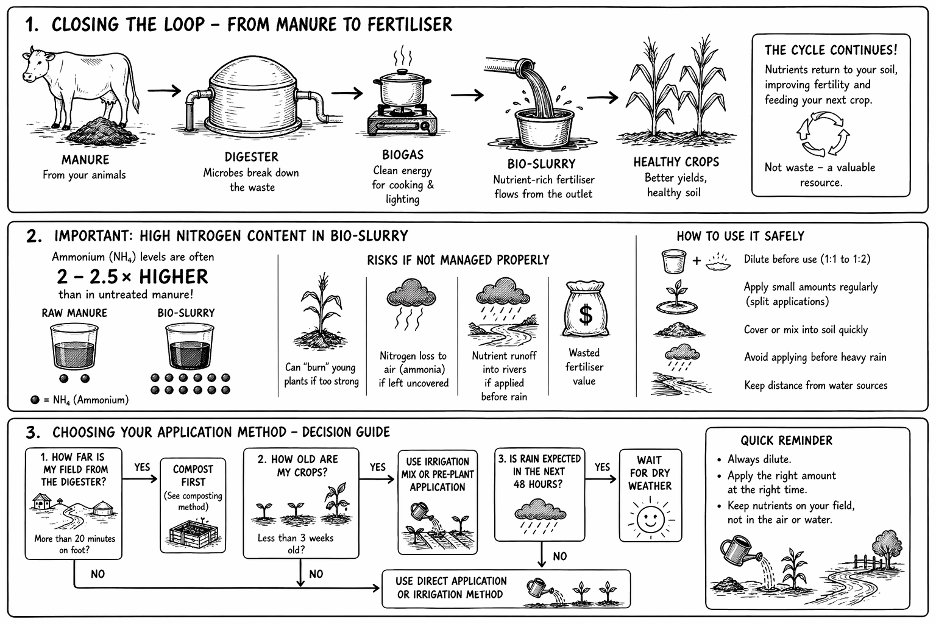
Fig. 16 Closing the loop: manure enters the digester, bio-slurry exits as a high-nitrogen fertiliser, and crops return organic matter — along with a quick-reference guide for choosing your application method.#
Why is Bio-Slurry Different from Raw Manure?#
Nutrient Content#
Anaerobic digestion does not reduce total nutrients (N, P, K), but it changes their form:
Much organic nitrogen is converted to ammonium-N (NH₄-N) — a form plants absorb immediately.
NH₄ levels in digested manure are often 2–2.5× higher than in undigested manure.
Total N, P, and K remain similar.
Note
Key finding: Bio-slurry can contain 44–81% of total nitrogen as ammonium-N. This means it acts faster than raw manure — but timely, correct application is essential to avoid nutrient losses or crop burning. (Möller & Müller, 2012; Gurung, 1997)
Forms of Bio-Slurry#
Form |
Description |
Best for |
|---|---|---|
Liquid bio-slurry |
Flows from digester outlet |
Quick nutrient supply to established crops |
Solid (fibre) digestate |
Settled solids |
Soil structure improvement, distant fields |
🔬 Bio-Slurry vs Raw Manure
Click a property to compare — see why digested slurry outperforms raw manure as a fertiliser.
Benefits of Bio-Slurry#
Plant nutrient supply: Provides N, P, and K in plant-available forms.
Soil health: Boosts organic matter and water-holding capacity.
Cost savings: Reduces the need for chemical fertiliser purchases.
Environmental gains: Fewer greenhouse gas emissions than unmanaged manure.
Crop health: Some field observations report improved plant resistance to bacterial wilts and insect pests, particularly on banana crops. Rice seedlings soaked in diluted bio-slurry before transplanting show improved germination and early growth. Evidence is largely observational; no peer-reviewed trials confirm resistance to specific viral pathogens. (Warnars & Oppenoorth, 2014)
Yield increases: 10 t/ha application to maize has been shown to increase yields. Results vary by soil, climate, and crop type. (Warnars & Oppenoorth, 2014)
Choosing Your Application Method#
Before applying, answer three questions:
How far is my field from the digester? (More than 20 min walk → compost first)
How old are my crops? (Less than 3 weeks old → use diluted irrigation method only)
Is rain expected in the next 48 hours? (If yes → wait)
🌿 Which Method Should I Use? — Decision Tool
Answer the three questions to find the right application method.
Method 1 — Direct Application#
Best for: Established crops, nearby field, no rain forecast.
Dilute fresh liquid bio-slurry 1:1 with water before applying.
Apply in a ring around plant bases or along crop rows.
Cover lightly with soil immediately to reduce nitrogen loss.
Do not apply to plants close to harvest date.
Do not contact plant stems, seeds, or seedlings directly.
Worked Example: 10 m × 10 m Maize Plot#
Add 20 litres of water to 20 litres of bio-slurry (1:1 ratio) = 40 litres diluted.
Pour ~0.5 litres around the base of each maize plant (30 cm from the stem).
Cover each application with a handful of soil.
Repeat 3–4 weeks later.
Method 2 — Surface Irrigation / Watering Can#
Best for: Seedlings or small plots where direct application would burn plants.
Warning
Never use bio-slurry in drip or trickle irrigation systems. Bio-slurry causes severe emitter clogging through bacteria, solids, and mineral precipitates. Use Method 1 instead.
Mix bio-slurry at 1:3 ratio (1 part slurry : 3 parts water).
Pour into upstream furrow channel or use a watering can.
Apply once every 2–3 weeks until plants are established; then switch to Method 1.
Method 3 — Composting Bio-Slurry#
Best for: Distant fields, food crops, or when immediate application is not safe.
A 100-day composting process makes bio-slurry safer, lighter, and longer-lasting — comparable to commercial peat fertiliser.
Building a composting pit:
Dig a pit at least 1 m away from the digester.
Line with dry organic material (dry grass or banana leaves).
Direct overflow bio-slurry into the pit and mix with organic waste.
Cover the pit to maintain moisture.
Aerate weekly by turning with a fork.
Once full, start a second pit and allow the first to compost for 100 days.
Tip
An average digester produces ~30 tonnes of slurry per year, fertilising approximately 1 acre. Well-composted, the same slurry can fertilise up to 3 hectares — a threefold gain through volume reduction and improved nutrient retention. (SNV, 2023)
When and how to apply composted bio-slurry:
Apply before planting or during early growth stages.
Avoid applying within 48 hours of rain.
Do not use on waterlogged soil.
Maintain safe distances: at least 50 m from drinking-water sources, 10 m from surface water bodies.
Quick Reference: Choosing Your Method#
Situation |
Method |
Dilution |
Notes |
|---|---|---|---|
Established crops, nearby |
Direct (Method 1) |
1:1 |
Cover soil after application |
Seedlings / surface irrigation |
Method 2 (furrow/can — NOT drip) |
1:3 |
Never undiluted on seedlings |
Pre-planting |
Composted |
None |
Incorporate into top 10 cm |
Distant field (>20 min) |
Compost first |
None |
Reduces volume ~3× |
Fresh vegetables |
Composted only |
None |
6+ weeks before harvest |
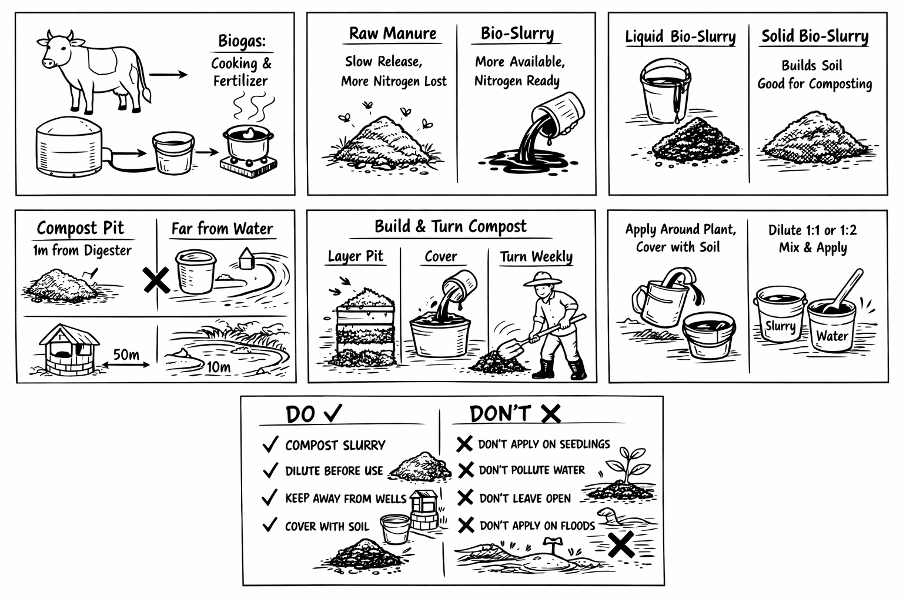
Fig. 17 Bio-slurry forms and how to use them: liquid and solid bio-slurry, building compost, and the key do’s and don’ts for safe application.#
🌱 Bio-Slurry Application Calculator
Enter your plot size and application method — find out how much slurry and water you need.
Challenges and How to Manage Them#
High nitrogen content — risk of plant burn#
High ammonium-N can burn young plants and cause losses if misapplied.
Always dilute liquid bio-slurry (minimum 1:1, 1:3 for seedlings).
Use composted material for sensitive crops.
Apply small amounts more frequently (split applications over the season).
Nitrogen loss during handling#
Ammonia volatilises when slurry is left uncovered, spread thinly across a surface, or dries in hot sun. Significant nitrogen can be lost this way, reducing fertiliser value and causing odour. Surface broadcast without soil incorporation is particularly prone to losses.
Cover storage and composting pits at all times.
Incorporate bio-slurry into the soil immediately after application.
Avoid spreading during hot, windy conditions.
Uneven nutrient distribution#
Irrigation channel application can lead to uneven spread.
Dilute before mixing with irrigation water.
Rotate inlet positions across the plot.
Use buckets or watering cans for small plots to ensure even coverage.
Nutrient runoff and water pollution#
Heavy rain after application can wash nutrients into water bodies.
Never apply before forecast rain.
Observe safe buffer distances from water sources (50 m from drinking water, 10 m from surface water).
Transport and labour#
Bio-slurry is bulky and heavy to move to distant fields.
Prioritise nearby plots for liquid application.
Compost to reduce volume before carrying to distant fields (reduces mass ~3×).
Health, Safety, and Pathogen Risk#
This is one of the most important sections. Bio-slurry from animal manure is generally safe when handled correctly, but risk levels vary significantly depending on what went into the digester.
Mesophilic digesters (20–40°C — the most common type in smallholder settings) do not fully eliminate pathogens. Salmonella, E. coli, and helminth eggs can survive the digestion process, particularly with short retention times.
Thermophilic digesters (50–60°C) achieve a higher degree of pathogen kill but are less common in rural Africa. Even here, composting the output adds a further safety margin. The 100-day composting process substantially reduces pathogen loads in all cases.
Risk level |
Applies when |
What to do |
|---|---|---|
🟢 Green — Safe |
Composted animal manure digestate only (cattle, pig, poultry) |
Suitable for all crops including fresh vegetables. Apply 6+ weeks before harvest as an extra precaution. |
🟡 Amber — Caution |
Fresh liquid digestate from animal manure only |
Safe when diluted 1:1 and applied to established crops. Avoid on root vegetables or crops where slurry contacts the edible part. Wash hands after handling. |
🔴 Red — Restrict |
Digesters co-digesting human waste (night soil, latrine contents) |
Do not apply to food crops without composting first (minimum 100 days). Apply only to non-food crops or as pre-planting soil amendment. Strict hygiene essential. |
General hygiene:
Wash hands with soap and water after handling bio-slurry.
Wash all tools (buckets, jerry cans, watering cans) after use.
Do not eat, drink, or touch your face while working with slurry.
Keep children away from composting pits and slurry storage areas.
If bio-slurry contacts skin, wash immediately with clean water.
Session 5 Quiz#
MC Q1. Why is bio-slurry often more effective than raw manure as a fertiliser?
Fill in Q2. What is the recommended dilution ratio of liquid bio-slurry to water for applying to established crops?
Express as a ratio (slurry : water).
MC Q3. Why should you never use bio-slurry in a drip irrigation system?
Number Q4. How many days must bio-slurry compost before it is safe to apply to sensitive food crops?
MC Q5. Which traffic-light risk level applies to fresh liquid digestate from animal manure only?
True / False Q6. Applying bio-slurry within 48 hours of expected heavy rain is wasteful because runoff will carry nutrients away.
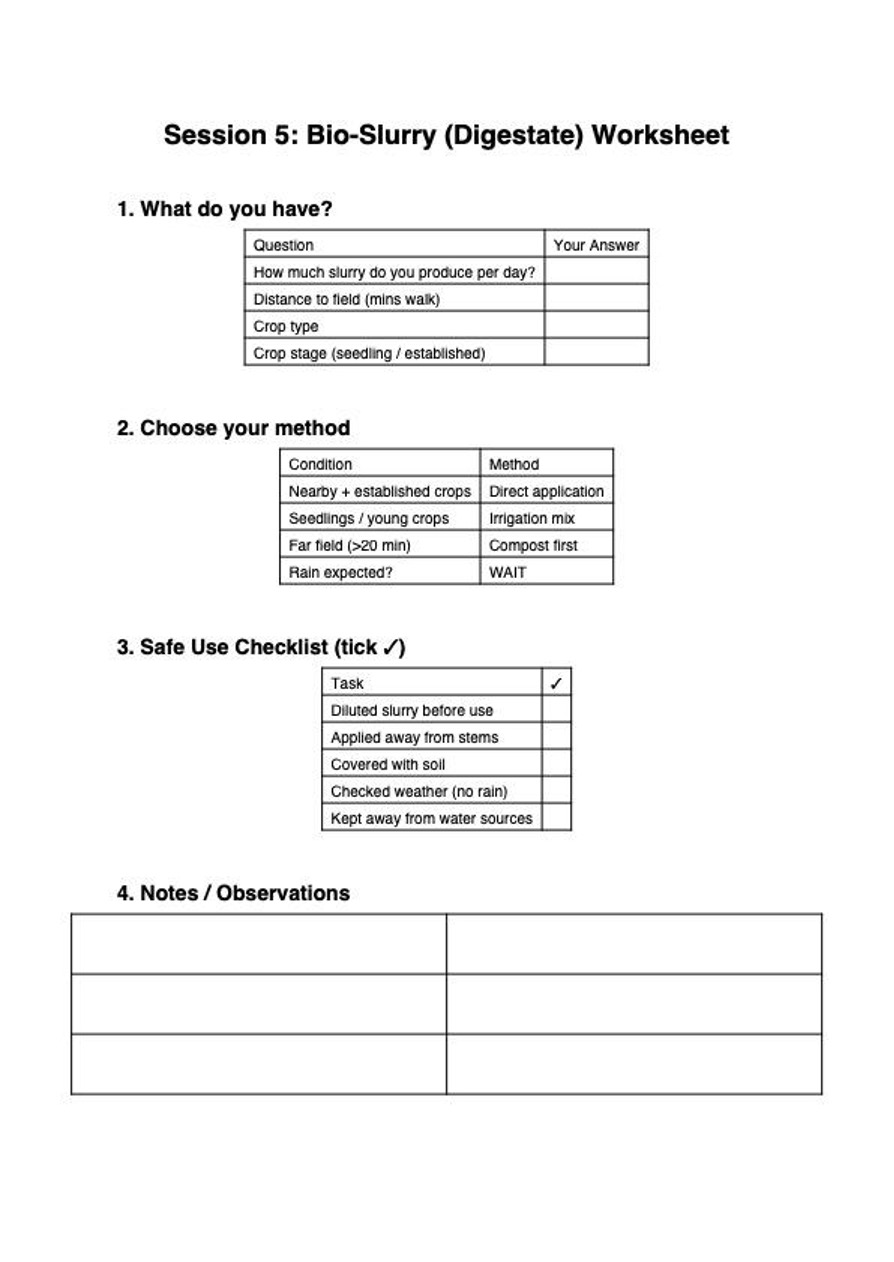
Fig. 18 Use this worksheet to plan your bio-slurry application: record your daily slurry volume, choose your method, and tick off the safe use checklist.#
Note
Key things to remember from Session 5
Bio-slurry is the transformed fertiliser that completes your biogas system — the manure you fed in Session 2 becomes the fertiliser you apply now.
Choose your method based on three questions: distance, crop stage, and weather.
Always dilute liquid slurry (1:1 for established crops, 1:3 for seedlings).
Composting for 100 days makes bio-slurry safer, lighter to carry, and longer-lasting.
Know what went into your digester — human waste co-digestion requires composting before any food crop application.
For maize, 10 t/ha (approximately 1,000 litres undiluted per 0.1 ha plot) has been shown to increase yields — split into 2–3 applications per season. (Warnars & Oppenoorth, 2014)
References#
The following sources underpin the content of this session. Those marked ★ are particularly recommended for practitioners wanting to go deeper.
★ Warnars, L. & Oppenoorth, H. (2014). Bioslurry: A Supreme Fertiliser — A Study on Bioslurry Results and Uses. SNV/Hivos. Covers smallholder field evidence across Africa and Asia, including per-plant and per-hectare rates. Start here if you only read one reference.
★ Gurung, B. (1997/1998). Training Manual: Proper Utilisation of Bio-Slurry. Biogas Support Programme (BSP/SNV), Nairobi. The original practitioner guide with dilution ratios, crop-by-crop guidance, and composting pit instructions.
★ SNV (2023). Biogas, Food Security and Climate Change. snv.org. Overview of bio-slurry value chains in Africa, including the 30 t/year output figure and 3 ha composting yield.
Möller, K. & Müller, T. (2012). Effects of anaerobic digestion on digestate nutrient availability and crop growth: A review. Engineering in Life Sciences, 12(3), 242–257. [Source of NH₄-N data: 45–80% of total N as ammonium, 2–2.5× uplift over raw manure.]
Bonten, L.T.C. et al. (2014). Is bio-slurry from household digesters a better fertilizer than manure? A literature review. Alterra Report 2519, Wageningen UR.
Kisaka, M.O. et al. (2023). Smallholder farmers’ knowledge on the use of bioslurry as soil fertility amendment for potato production in Kenya. Land Degradation & Development, 34(3).